Sunday, 14 May 2017

THE PYJAMA GIRL CASE (1977) review


The severely burned and mutilated corpse of a young woman clad in yellow pyjamas is discovered in an abandoned car wreck on a Sydney beach. Her face has been disfigured beyond recognition, and the only clues remaining which could possibly identify her are the pyjamas and a few grains of rice found nearby. Retired but restless Inspector Timpson (Ray Milland) is intrigued by the case, and sensing that the enquiry undertaken by his former colleagues is going nowhere – as they are more concerned with beating confessions out of potential suspects and wrapping things up as quickly as possible - he joins the investigation. Timpson's old-fashioned, methodical detective work turns out to be much more fruitful than that of the younger officers, and his efforts lead to piecing together the identity of the woman, Glenda Blythe, and unfolding the mystery of her tragic death.


Glenda (Dalila Di Lazzaro), a beautiful but troubled Dutch immigrant, has a rather complicated love life – she is having simultaneous affairs with fellow recent arrival Antonio (Michele Placido), a penniless but hardworking Italian; Antonio's best friend, slimeball Roy (Howard Ross); and the cashed-up Professor Douglas (Mel Ferrer). Glenda eventually marries Antonio, hoping that their union will lead to the happiness she desperately seeks. However she quickly becomes disillusioned as she sees herself and Antonio tied to their menial waiting jobs and living in a cramped Kings Cross apartment forever and resumes her liaisons with Roy and the professor. Glenda's impulsive desires for love, attention and the trappings of a comfortable lifestyle lead to her life spiralling out of control, humiliating sexual degradation…and to her brutal death. But who committed the horrific crime? Inspector Timpson knows the answer – but will he survive to see Glenda's killer brought to justice?


A stylish, unique murder mystery from former art director Flavio Mogherini, The Pyjama Girl Case is loosely based on a true crime that took place in Australia in the 1930's. Though often catergorised as a giallo, the film is one of the more unorthodox entries of the subgenre as it steers clear of expected key elements – there is no rampaging black-gloved killer, no trail of bloody, over-the-top murders and no baroque Italian architecture (the story is set in contemporary 1970's Sydney). Despite its lurid title, those expecting a sensationalistic, gory late entry in the giallo cycle might be let down by The Pyjama Girl Case, but the film is actually a highly ingenious 'whodunit', a fascinating character study, a police procedural, and a visually striking experience.

The plot is split into two halves; the first is the investigation into Glenda Blythe's murder, and the second is the story of the doomed woman’s life up until it ended (which is revealed in flashbacks). The pleasant, sun-drenched cinematography of Sydney's landmarks, beaches and parks contrasts sharply with the film's downbeat and occasionally voyeuristic and sleazy tone (including a memorable scene of the baffled authorities putting Glenda's naked corpse on public display in a glass case, attracting hordes of sweaty, morbid curiosity seekers). A subtext of the movie is isolation – in Glenda and Antonio's case having to adapt to a new, unfamiliar country (wonderfully realised in shots of the couple wandering around the strangely underpopulated city streets and Opera House, creating an alien, lonely atmosphere and dwarfing the characters by their surroundings).

The Pyjama Girl Case features a solid cast, the standout being Oscar winner Ray Milland as the cantankerous, world-weary Inspector Timpson. Milland steals the show by injecting humour into his character - his expressions and mannerisms when having to deal with a procession of oddball and sexual deviant characters are priceless. Dalilia Di Lazzaro is excellent as the doomed 'Pyjama Girl' Glenda; a former model usually cast as decorative eye-candy, clearly relishes the chance at actually being required to 'act' and though Glenda is often impulsive and irresponsible, Di Lazzaro manages to bring depth and sympathy to the role. Also worth mentioning are Michele Placido as the gullible, hopelessly lovestruck Antonio  and Howard Ross in typical oily form as meathead Roy, who gives the naive Antonio helpful pointers on women such as : "If you want their respect you have to slap them around a bit, treat them like dogs and let them know who their master is".
The Pyjama Girl Case is an innovative and successful rework of the giallo genre with an uncharacteristic plot structure, intriguing twists, and above-average performances, as well as an air of morbidity and quiet desperation that tends to creep up on the viewer rather than immediately pack a punch.

Wednesday, 26 April 2017

'Lost Girls: The Phantasmagorical Cinema of Jean Rollin' to be published August 2017


I'm very proud to have participated as a contributing writer to the upcoming book Lost Girls: The Phantasmagorial Cinema of Jean Rollin, to be published by Spectacular Optical in August 2017. A collection of essays on the cinema of Rollin written entirely by female film critics and historians, this will no doubt be one of the most anticipated genre titles of the year.
**LATEST INFORMATION HERE INCLUDING PRE-ORDER DETAILS, FULL TABLE OF CONTENTS AND SAMPLE PAGES HERE**
https://www.indiegogo.com/projects/lost-girls-the-cinema-of-jean-rollin-film-feminism#/


From Spectacular Optical:

"...this collection of essays covers the wide range of Rollin’s career from 1968’s LE VIOL DU VAMPIRE through his 2010 swansong, LE MASQUE DE LA MÉDUSE, touching upon his horror, fantasy, crime and sex films—including many lesser seen titles. The book closely examines Rollin’s core themes: his focus on overwhelmingly female protagonists, his use of horror genre and exploitation tropes, his reinterpretations of the fairy tale and fantastique, the influence of crime serials, Gothic literature and the occult, as well as much more. Curated and edited by Samm Deighan (DIABOLIQUE), contributors to LOST GIRLS include some of the most important critical voices to emerge over the last decade of genre journalism: Alexandra Heller-Nicholas (SENSES OF CINEMA), Kat Ellinger (DIABOLIQUE), Virginie Selavy (ELECTRIC SHEEP), Alison Nastasi (SATANIC PANIC: POP-CULTURAL PARANOIA IN THE 1980s), Marcelline Block (ART DECADES), Rebecca Booth (DIABOLIQUE), Michelle Alexander (CINEMADROME), Lisa Cunningham (THE LAUGHING DEAD: THE HORROR-COMEDY FILM FROM BRIDE OF FRANKENSTEIN TO ZOMBIELAND), Heather Drain (DANGEROUS MINDS), Erin Miskell (THAT’S NOT CURRENT), Gianna D’Emilio (DIABOLIQUE)—and more to be confirmed.


Thursday, 13 April 2017

Interview with writer and film historian Robert Monell


Many rabid Eurocult film fans would have seen the name Robert Monell at least once when reading up on the subject, as he is a veteran film writer of four decades, and undoubtedly one of the most talented and prolific journalists specialising in the European horror, cult and arthouse genres. Throughout his career, his articles and essays been published internationally in books, newspapers, magazines and online. A few books Robert has contributed to are Francesco Cesari’s Il Caso de Jesus Franco, Tim Lucas’ All the Colors of the Dark and Jay Slater’s Eaten Alive: Italian Cannibal and Zombie Movies. Robert’s enthusiasm for cinema has led him to become involved with all aspects of filmmaking – he’s also directed and written short films and plays since 1971. Also respected as one of the world’s leading authorities on legendary Spanish director Jess Franco – his knowledge of the man and his movies has probably never been rivalled. He is the creator and webmaster of I’m in a Jess Franco State of Mind, which has been the number one English-language web resource on the cinema of Jess Franco for over ten years. Robert was kind enough to take a break from his busy writing schedule to have a chat...


What are your all-time favourite films (of any genre) and whom do you believe are the greatest directors of all time?

Hard questions. I am interested in all kinds of films from experimental, to genre, to classic Hollywood, to Eurohorror, to Japanese science fiction, to German expressionist classics like Nosferatu to B cult films of the Corman factory and even the Warhol factory era. The stuff that interests me the least is contemporary mainstream fare. Every year to two there might be one interested film. Haven't seen that many in the 21st Century so far, but I found Jim Jarmusch's Limits of Control, Lynch's Inland Empire and Refn's Only God Forgives very interesting. But they are hardly mainstream. I have long been fascinated by the surrealist school of filmmaking, especially Luis Bunuel's films of the late 1920s. Un Chien Andalou which he made with Dali, was a huge influence on my very first film, made in 1971. His grim Los Olvidados, shot in the slums of Mexico City is one of the greatest film's I've ever seen. Also Jean Cocteau's Blood of a Port and Orpheus, an idol of Andy Milligan also, who wrote a play about him. They were early Independent surrealists, funded by wealthy people they lobbied for funds. I like Pasolini a lot, especially Teorema, which was the first Art film I ever saw, and his period films like The Arabian Nights and Salo. I like people like Jack Smith (Flaming Creatures) who founded gay cinema and performance art, but he didn't give a shit about promoting himself, an attitude I appreciate. I also like extreme genre stylists, like Sam Peckinpah's explosive westerns and crime dramas and the Japanese crime dramas and blood spattered historical action films of Teruo Ishii. He was a real outlaw who also worked within strict studio guidelines. I don't differentiate between Art films, experimental, Hollywood, Japanese or Euro genre films, they're all cinema to me. Some people who like Art films from Europe look down on genre films like 2000 Maniacs or a Doris Wishman film. I don't. Doris Wishman's outtake masterpiece A Night to Dismember, is one of my favorite films because she breaks every rule of polite filmmaking to get it done her way. It's kind of a Z noir gore film featuring a hardcore actress who has no sex scenes. And it's only a bit over 60 minutes. I love short films. When I interviewed Ray Dennis Steckler, another series Z idol, he told me that no film should go over 50 minutes. I tend to agree with that. Recently I've gotten into the situational school of experimental films from people like Guy Debord, who had no commercial ambitions whatsoever. I also like Italian horror, specifically The Horrible Dr. Hitchcock, which might be my all time favorite from that school.

You are well-known to be one of the world’s leading authorities on the works of the late, legendary Spanish director Jess Franco. What are your own personal favourite films of his, and which titles would you recommend to a ‘first time’ JF viewer as an introduction?

I used to hate Jess Franco based on some US television broadcasts of some of his films. The two I remember most vividly were Count Dracula and The Castle of Fu Manchu, they both just seemed incredibly shoddy and lazy in terms of direction. I swore I'd never watch one of his films again, I was a big fan of Hammer horror at the time, but that all changed. The Franco films I really like are not the ones he made with Harry Alan Towers and Christopher Lee but his very low budget crime films and horror y sexo like Eugenie de Sade with Soledad Miranda and Lorna the Exorcist with Pamela Stanford and some of his 1980s films which are not well known. Also his earlier Necronomicon (titled Succubus here in the US) and Female Vampire, a very poetic film with almost no dialogue. His best films are purely visual and filled with classic jazz music and his own very bizarre compositions. I would recommend The Diabolical Dr. Z to anyone wanting to get into the world of Jess Franco. A good place to start, a fun, stylist and unique medical horror film.

How and when did you discover and really get into horror/trash/cult cinema?

At the Drive-in movies I used to go to in the mid 1960s into the mid 1970s. Watching things like Blood Bath, The Conqueror Worm, Blood from the Mummy’s Tomb, Destroy all Monsters, then the famous double bill of Twitch of the Death Nerve and Slaughter Hotel, Mario Bava's Kill, Baby Kill! also impressed me at another Drive-in visit. I saw Andy Milligans' Torture Dungeon and Bloodthirsty Butchers as a double bill and wondered how anyone could make such poorly acted and photographed films. Films like Private Parts, The Devil’s Wedding Night and Death Race 2000 were all mid 1970s cult films I remember seeing and enjoying at those showings.

When did you first discover a like-minded ‘community’ of fans/collectors of these films whom you could correspond and collaborate with?

In the late 1980s when I started going to video stores after getting a VCR and renting all kinds of things. I heard about "zines" and started to look for them and read them. Then I stated publishing my own reviews in zines like Blood Times, European Trash Cinema, Spaghetti Cinema, Euro Bis, Westerns All Italiana, etc. I've also had articles published in the Italian publication Nocturno and in books such as Eaten Alive, published in the UK and Il Caso de Jess Franco, published in Italy, for which I wrote the foreward. I also contributed material to the Tim Lucas Mario Bava biography, All the Colors of the Dark. My longest publication was when I wrote an entire issue of European Trash Cinema, Special #2, on the film career of Italian genre specialist Riccardo Freda. Before all this, in the 1970s and 80s, I wrote a lot of short film scripts, some of which I made into films. I also wrote a number of plays in the 1980s, some of which got staged readings. I recently resumed writing film scripts.

What are your fondest memories of your time as a contributing writer for Craig Ledbetter’s European Trash Cinema, one of the most respected fanzines of the 1990s?

Well, I had my own column, which I named Trashman on the Prowl, in which I could cover whatever I wanted. I had a lot fun writing about obscure genre stuff which wasn't available on video or DVD back then, and some of which still isn't. Also doing the special Freda edition was an achievement since it took a lot of time and research. I also am proud of an interview I did with the late Spaghetti Western actor Charles Southwood (Roy Colt and Winchester Jack) who told me a lot of interesting stories about working with Mario Bava and many other European directors.

Who are your current favourite film writers?

I try not to read other contemporary writers. There aren't many film publications I read anymore. I used to like Film Comment back in the 1970s a lot and some foreign magazines like Giallo Pages and Continental Film Review. My all time favorite critical writer was Susan Sontag, who wrote about everything from Japanese science fiction to Bresson to the New York Underground. Her piece on Jack Smith and the New York Underground of the 1960s is essential. I don't relate to the present day mode of conventional film criticism. It all reads the same to me. They all use the same words, phrases and have the same look-at-me attitudes. I do admire writers Alain Petit and Francesco Cesari as writers on Jess Franco and Roberto Curti on Italian Cinema. And Nzoog Wahrlfhehen whose knowledge of Spanish cinema is outstanding. 

What general advice would you offer to writers of cinema discussion and criticism wishing to establish themselves?

I would advise them not to get into film criticism if they think they are going to make a living at it and to write about what they are passionate about in a unique way and not read other contemporary film critics.

You’ve been involved with various forms of media for over four decades to date – writing for books, newspapers, magazines and online, filmmaking, directing plays. What are some of your thoughts on the vast technological changes you’ve observed and adapted to in your involvement in these fields during this time?

I started writing film articles for a local paper in 1971. I was reviewing mainstream US movies then. But mainstream cinema was much more interesting back then. I got paid pretty well. A few hundred dollars a week of articles, reviews and interviews. Then I got into magazine publications in the late 1980s, but that's changed a lot. Many have folded. The Internet has changed everything. I still make films, but with a cellphone! I still write scripts and have collaborated with the Russian filmmaker Alex Bakshaev on some projects. He's a real visionary. One of the world's best contemporary directors. A true original. It's more difficult to make films now. You have to make video, unless you're Quentin Tarantino. And there's a world of competition out there with the Internet. Hard to get attention. Even big budget films get lost in the shuffle today.

I know you’ve met a fair few individuals in the public eye – actors, directors, musicians. What are some of your most memorable ‘celebrity’ encounters, good or bad?

Meeting and having a few drinks with Nicholas Ray in 1972 was memorable. He was working on his experimental film in nearby Binghamtom N.Y. I met him at the Everson Museum and then had several meetings with him. He didn't seem to be in good health but he was very engaging and direct. He hated mainstream films as much as I did and I remember him praising Bunuel and some European directors. I also met Sam Fuller in 1981 and watched his German made crime film Dead Pigeon on Beethoven Street with him sitting nearby. He was a great raconteur and he very encouraging to me when I told him I was a writer and independent filmmaker. He even gave me the address of his agent. He was very generous and had an anti-Hollywood attitude which I respected. He was a unique genre stylist. I also got a chance to have a number of long distance phone conversations with Jean Rollin when I conducted an interview with him in 1990. It was a bad time for him, he was ill and trying to find film work but he was very generous with his time and sent me a large package of behind the scene photography from his film career. He was a very gentle, humble and film obsessed person. A real cult movie fan.

What works or projects are you most proud of, and what are some of your current and future projects you’d like to mention?

Probably the European Trash Cinema issue on Riccardo Freda which I wrote and the web series which I wrote and was filmed in Voronez by Alex. It's actually on Blu-ray in Spain. Also some of the plays I wrote had some very good readings which provoked some memorable audience feedback. My main projects now are to complete a feature style film script and work on some fiction rather than journalism. I also got my name on the credits of a Jess Franco film, his final one. I never expected that and thank the producer, Ferran Herranz.


Friday, 7 April 2017

Tina Russell's 1973 autobiograpy 'Porno Star'


Thanks to Keith Crocker, I recently had the chance to read the ultra rare Tina Russell 1973 autobiography 'Porno Star'. At the time Tina and her then-husband Jason Russell were amongst the most prolific and well-known stars of the dawn of the adult film industry. Filled with her on and off screen exploits, Tina also had much to say about her co-stars and directors (thinly disguising them under easy to guess pseudonyms), including Harry Reams, Marc Stevens, Jamie Gillis, Gerard Damiano and Andrea True. Unfortunately only a couple of years later her life would dramatically unravel. Jason Russell left his wife, in a particularly cruel way, for the underage Jean Jennings. A shattered Tina, whose adoration of Jason is clearly expressed in the book, descended into a spiral of chronic alcoholism and depression, resulting in her tragic premature death at 32. Though largely forgotten today, Tina Russell is to me personally one of the most memorable adult stars because she had an inner and outer beauty, intelligence and charisma which stood out in a predominately generic industry. For a wealth of info on Ms Russell, the invaluable Rialto Report podcast on her life and death is a MUST.

Friday, 3 February 2017

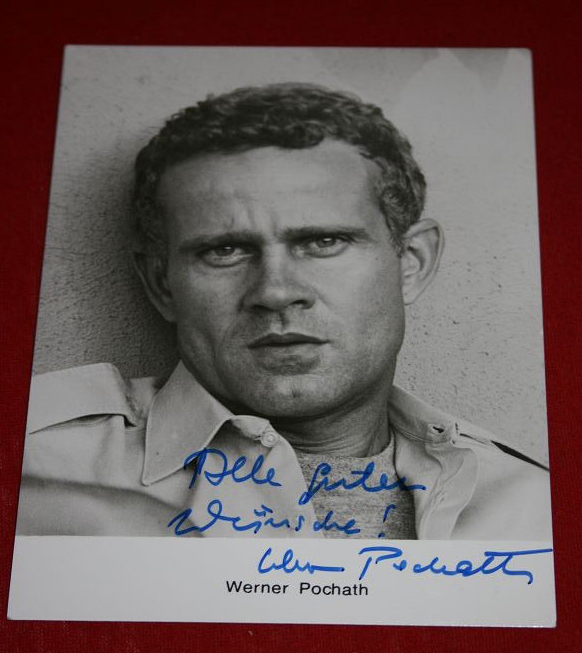
Werner Pochath: a tribute to a favourite actor

 One of my absolute favourite images - Werner Pochath with the equally great Franco Nero, 1980.


Sadly an almost forgotten talent, the late great Werner Pochath is one of my favourite actors. Criminally underrated and usually unfairly dubbed ‘the poor man’s Klaus Kinski’ (though of course Kinski is a brilliant actor, Pochath also is in his own right), his intensity and unique, instantly recognisable face always was a bonus even to the worst of cinematic material.
 Young Pochath


Born Werner Pochlatko in 1939 in Vienna, Austria, Pochath first appeared in the public eye as a youth figure skating champion of his homeland.  His thespian career began in both stage and television productions in 1959, and Pochath worked steadily in these fields until his 1967 film debut in the German crime drama Der Tod eines Dopplegangers. Movie offers also came quickly to the gifted young star after relocating to Rome in 1968. Often cast as ruthless, psychopathic villains, Pochath was a popular casting choice for low-budget European horror, exploitation and action directors. His trademark ruthless sadists can be viewed in Ferdinando Baldi’s Terror Express, The Shark Hunter by Enzo G. Castellari, Lucio Fulci’s Challenge to White Fang, and, although it’s one of Jess Franco’s least distinguished titles, it’s still nice to see Pochath chewing up the scenery – The Devil Hunter. He also had smaller but memorable roles in Dario Argento’s  Cat O’Nine Tails and Riccardo Freda’s The Iguana with the Tongue of Fire.
Pochath as one of the thugs in the Last House on the Left cash-in Terror Express

What is possibly Pochath’s finest hour is his tremendous portrayal of the ‘The Vampire of Nuremberg’, Kuno Hofmann, in the disturbing 1977 real-life based horror Mosquito der Schander, aka Bloodlust. His role as the deaf-mute, blood drinking murderer is truly haunting, grim and unsettling. In the hands of a lesser actor the film would have most likely been little more than an exploitative mess, but Pochath manages to elevate the material to another level.
Pochath as the real-life 'Vampire of Nuremberg' Kuno Hofmann in Mosquito der Schander

Throughout the 1980s Pochath was appearing in more and more titles with unfortunately nil redeeming features, such as the horrendous Ratman and Cop Game. Tragically diagnosed with AIDS, Pochath mostly resigned from acting to become a casting directer under the name ‘Paul Werner’ though he still accepted the occasional film role. He passed away on April 18, 1993, at the age of 51 in the arms of his long-term partner John Neumeier, ballet director of the Hamburg State Opera. A greatly missed actor who always managed to shine no matter what he appeared in, Pochath’s legacy will hopefully live on for many more years via dedicated Eurocult film fans.     

**P.S. If anyone has or knows where I can find ANY interviews with Pochath, please let me know!**

Werner Pochath in Mosquito Der Schander


Sunday, 20 November 2016

The Lost Art of Horror VHS covers - U.S. edition

As a companion to my earlier post of original 1980s U.S. cinema newspaper ads (kindly supplied to me by Long Island independent filmmaker Keith Crocker (The Bloody Ape, Escape from Stalag 69), here's a - very small - sample of Keith's incredible VHS collection. This selection consists of some of my personal favourite U.S. VHS horror/trash cover art, most of which were released by the legendary Wizard Video.


Tuesday, 1 November 2016

Mike Patton's Eurocult Soundtrack Love Affair


Musical genius Mike Patton, whom I’ve written about at length elsewhere on this blog, is also well known for his love of the Eurocult genre, often mentioning specific movie titles and directors in interviews. And of course there’s his love letter to cinema, Fantomas’s tremendous Director’s Cut album. During many Mr Bungle shows, the band would deliver near perfect renditions of Morricone’s ‘La Lucertola’ (from A Lizard in a Woman’s Skin), Citta Violenta and other much welcome surprises for genre fans. Even with his experimental work Adult Themes for Voice, Patton slapped on titles such as ‘Porno Holocaust’ and ‘Red Mouth, Black Orgasm’ (guess which director he’s a fan of) onto some tracks. The man lives and breathes not only obscure music but also non-mainstream cinema, and film references are littered all over his 30-year career.
As this is specifically a Eurocult/Eurohorror/Eurotrash blog, I thought it would be fun to list as many songs Patton has covered or paid homage to via his myriad of projects.


Porno Holocaust

Track 8 off Adult Themes for Voice – Mike Patton

Title of a 1980 Aristide Massaccesi (Joe D’Amato) film

Porno Holocaust is a delirious 1980 porn/horror hybrid from the notorious Joe D’Amato. The track itself consists of Patton making screaming/puking noises for a minute. Mike’s statement on the no-budget craziness of the film? His expression of how in-your-face it is? Or he simply loved that killer title and said “Hell, this is what I’m going to name this”? Make of that what you will.


Red Mouth, Black Orgasm

Track 29 off Adult Themes for Voice – Mike Patton

Those In The Know will be aware of D’Amato’s 1980 opus Black Orgasm, which it appears Patton had on his mind when recording this 27 second soundbyte, which starts with him making sucking noises then barking FUCK FUCK FUCK for the rest of it. Pretty much sums up the film.


La Lucertola

Live cover by Mr Bungle

Originally composed by Ennio Morricone for the soundtrack of A Lizard in a Woman’s Skin; directed by Lucio Fulci, 1971

A stunning cover of ‘La Lucertola’, this rendition brings chills to the spine with its preciseness. 6 out of 5 stars.


A Lizard With the Skin of Woman

Track 17 off  Adult Themes for Voice – Mike Patton

Clearly a tribute to Lucio Fulci’s masterpiece A Lizard in a Woman’s Skin, Patton’s haunting, mournful, yet ominous vocal stylings would not be out of place in a 1970s Morricone giallo composition, or indeed in Fulci’s film itself.


Citta Violenta

Live cover by Mr Bungle

Originally composed by Ennio Morricone for the soundtrack of Violent City; directed by Sergio Sollima, 1970

No other words, Bungle’s stirring, thumping cover of a classic Morricone track simply rocks.


Deep Down

Track 4 off Mondo Cane – Mike Patton

Originally composed by Ennio Morricone for the soundtrack of Danger: Diabolik; directed by Mario Bava, 1968

Covering his idol Morricone once again, this is a superb, breezy rendition by Patton’s 60s Italian covers tribute album Mondo Cane off one of the tracks from the Mario Bava comic book/pop art extravaganza (also a favourite film of Patton’s). I actually prefer this to the original (sorry Maestro!)


Investigations of a Citizen Above Suspicion

Track 14 of The Directors Cut - Fantomas

Originally composed by Ennio Morricone for the soundtrack of Investigations of a Citizen Above Suspicion; directed by Elio Petri, 1970

More Morricone, this one begins in the spirit of a 70s Italo crime mystery, and ends with a thrash metal twist. Love it.


Twitch of the Death Nerve

Track 2 off She – Maldoror

Title of a 1971 Mario Bava film

A brutal cachopony of abrasive noise ala ‘Porno Holocaust’ from Patton and Japanese noise music artist Masami Akita, this is also open to your interpretation.....


Metti, una sera a cena

Live cover by Mr Bungle

Originally composed by Ennio Morricone for the soundtrack of Metti, una sera a cena; directed by Giuseppe Patroni Griffi, 1976

Another of Bungle’s live-only covers of – yep, another (very much welcomed) Morricone track, Patton nails Edda Dell’Orso’s exquisite vocals perfectly with his 6 and a half octave range.


Also of note is Crime and Dissonance, a 2005 compilation album of Ennio Morricone's generally lesser known work, focussing on Italian crime, horror and Giallo movies from the 1960s-1980s that he scored. Released by Patton’s record label Ipecac Records, I have listed the tracks from the album that are relevant to this article.

“Giorno Di Notte"
From A Lizard in a Woman’s Skin
Dir: Lucio Fulci, 1971

"Corsa Sui Tetti", ‘Spiriti’, “Fondate Paure” and “L’uccello dale piume di cristallo”
From The Bird with the Crystal Plumage
Dir: Dario Argento, 1970


“Il Buio” (Morricone/Bruno Nicolai)
From The Antchrist
Dir: Alberto Di Martino, 1974

“Seguita” and “Folle Folle”
From The Cold Eyes of Fear
Dir: Enzo G. Castellari, 1971

1970”
From The Cat O’Nine Tails
Dir: Dario Argento, 1971